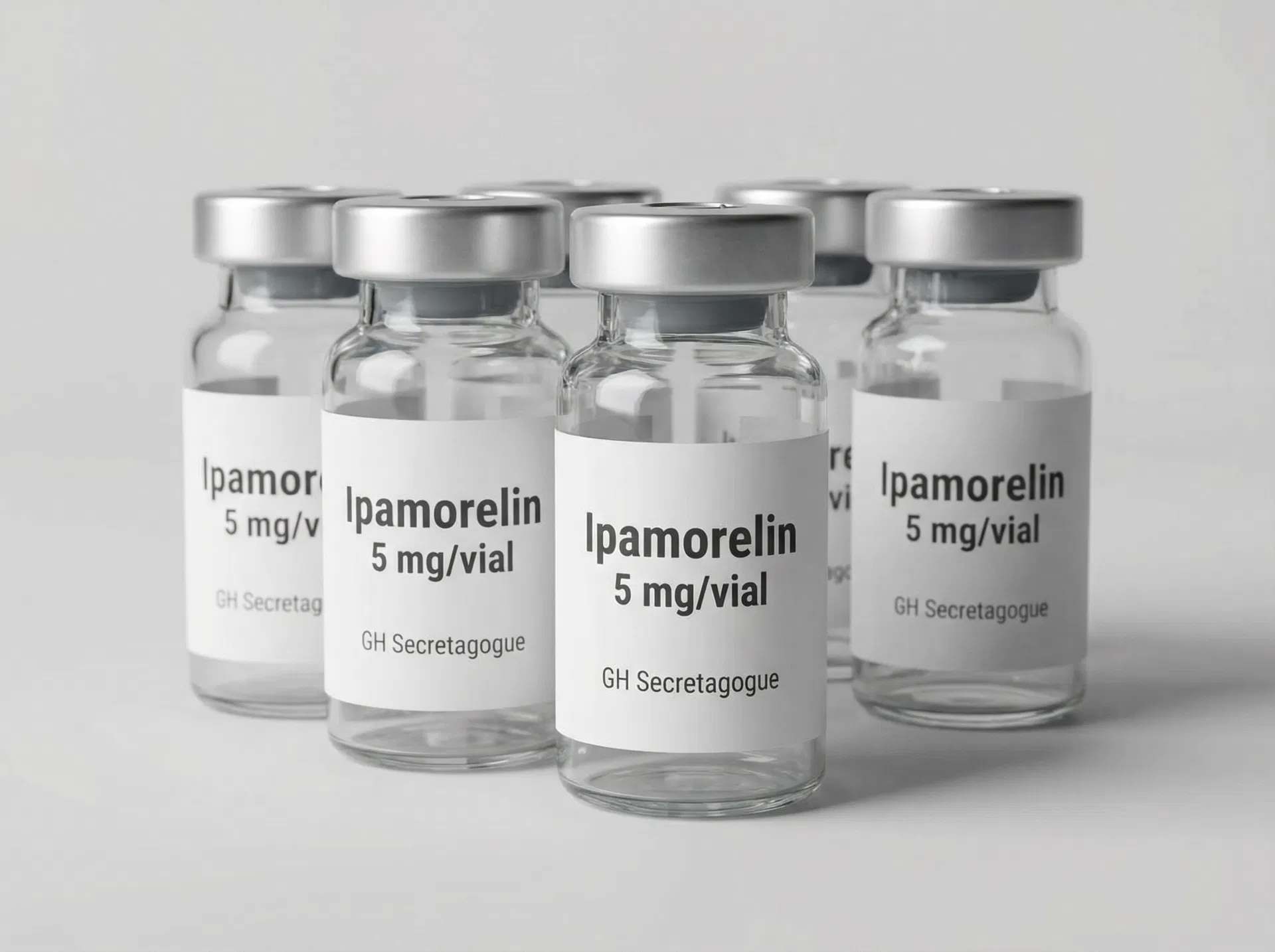
Ipamorelin
Growth Hormone Secretagogue
Ipamorelin is a selective growth hormone secretagogue and ghrelin mimetic. Unlike other GH secretagogues, it selectively stimulates GH release without significantly affecting cortisol, prolactin, or ACTH levels. This high selectivity makes it an ideal research compound for studying GH-related physiology. It is frequently combined with CJC-1295 for synergistic effects.
Key Benefits
Available Sizes
B2B Wholesale Only · For Research Use Only · COA Provided with Every Order
⚠ Legal Disclaimer: Products sold on this website are for Research Use Only (RUO). These products are not intended for human consumption, use in diagnostic procedures, or for any other clinical or therapeutic purposes. By purchasing, the customer acknowledges that these products are not drugs, medical devices, or supplements, and are to be handled only by qualified professionals in a laboratory setting.
Product Description
Ipamorelin is a selective growth hormone secretagogue and ghrelin mimetic. Unlike other GH secretagogues, it selectively stimulates GH release without significantly affecting cortisol, prolactin, or ACTH levels. This high selectivity makes it an ideal research compound for studying GH-related physiology. It is frequently combined with CJC-1295 for synergistic effects.
Amino Acid Sequence
Aib-His-D-2Nal-D-Phe-Lys-NH₂
Molecular Information
Request a Wholesale Quote
Fill out the form and our B2B team will respond within 24 hours with pricing, MOQ, and availability for Ipamorelin.
Related Research
Peer-reviewed scientific literature on Ipamorelin from PubMed, NEJM, The Lancet, and other authoritative sources.
Research Use Only. The following citations are provided for informational purposes and represent independent scientific research. These studies do not constitute medical advice or claims about our products. All products are sold for research purposes only and are not intended for human use.
Ipamorelin, the First Selective Growth Hormone Secretagogue
Raun K, Hansen BS, Johansen NL, et al.
European Journal of Endocrinology, 139: 552–561 (1998)
Ipamorelin demonstrated the highest selectivity for GH release among known secretagogues, with minimal effects on cortisol, prolactin, or ACTH—establishing it as the first truly selective GH secretagogue with a superior safety profile.
Growth Hormone Secretagogues and Muscle Protein Synthesis: Effects of Ipamorelin on Lean Body Mass
Svensson J, Lönn L, Jansson JO, et al.
Journal of Clinical Endocrinology & Metabolism, 83: 362–369 (1998)
GH secretagogue treatment significantly increased lean body mass, reduced fat mass, and improved muscle protein synthesis rates compared to placebo, with effects correlating with GH pulse amplitude and IGF-1 elevation.
Citations sourced from PubMed / NCBI, New England Journal of Medicine, The Lancet, Nature, and other peer-reviewed publications. DOI links lead to original publisher pages.